
Ask an Endries Expert: HVAC Q&A
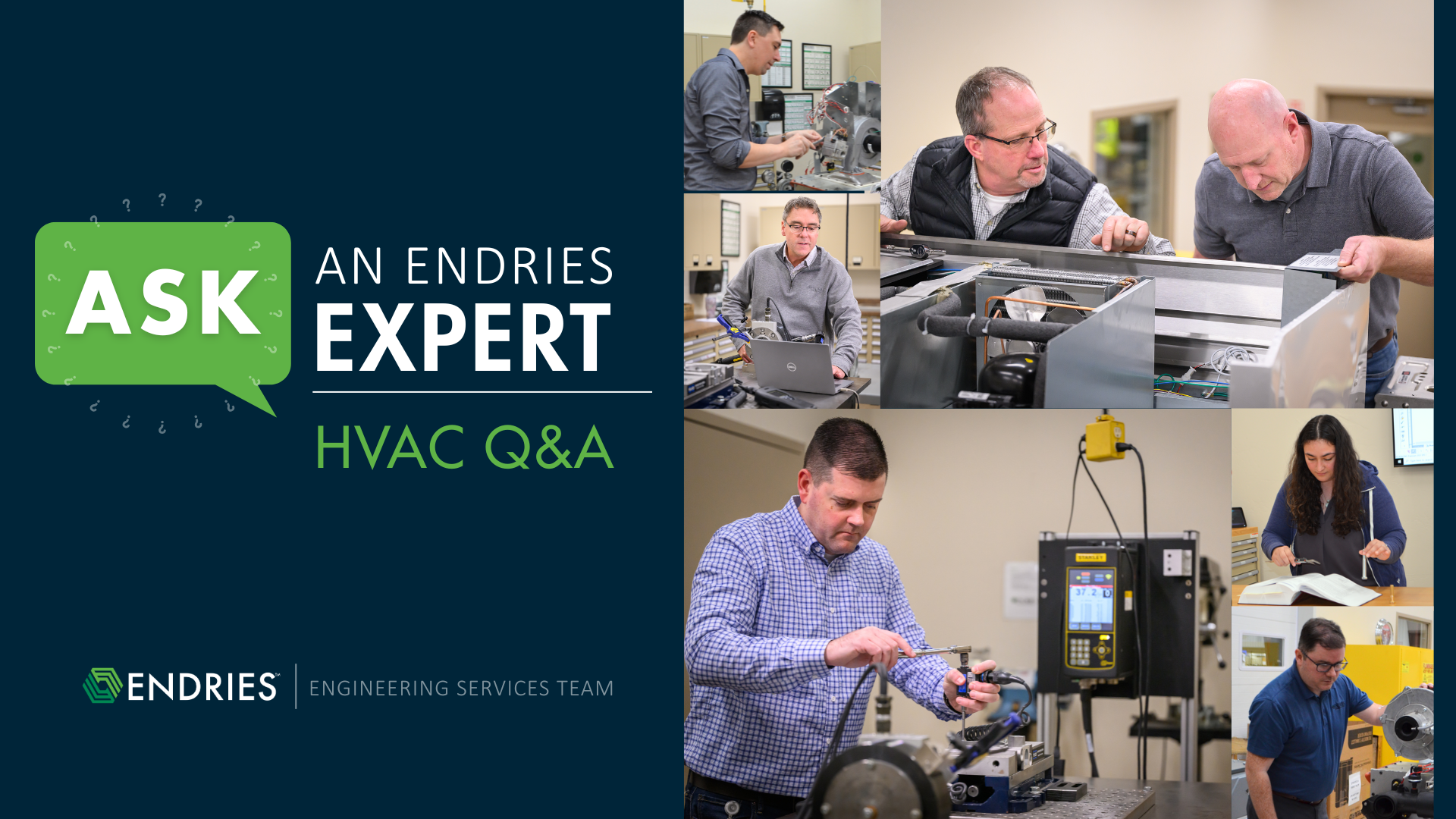
When precision and reliability define performance, even the smallest component can make the biggest difference. In HVAC manufacturing, fasteners may seem like an afterthought—but they’re often the key to stronger assemblies, faster production, and fewer long-term failures. In this edition of Ask an Endries Expert, our engineering team shares insights from the field—exploring how the right fastener design, coating, and specification decisions can transform everything from assembly speed to corrosion resistance. Whether you’re optimizing for automation, tackling mixed-material joints, or trying to prevent costly redesigns, these expert answers reveal what it truly takes to build HVAC systems that last.
What are the most common challenges HVAC manufacturers face when selecting fasteners, and how does our engineering team help solve them?
With HVAC manufacturers, the challenge is usually less about finding a fastener that works, and more about finding the optimal one — for performance, cost, assembly speed, and supply chain efficiency. Some considerations are: should the screw drill its own hole and tap its own thread, or should we add a hole and the screw just needs to tap its own thread, or should we add internal threads to eliminate the tapping operation?
Hardware is commonly the last thing thought of in an assembly, with the function of the product and the higher dollar components needed make that function happen, being addressed first. Sometimes this requires us to get creative on how to hold the assembly together. Things like panel fasteners (U-Clips, J-Clips, etc.), Rivet Nut Inserts, Clinch products, and Weld products become popular options. One thing common with all of these is, they don’t require access to the back side, to hold the fastener in place for assembly. Depending on the availability of the fasteners and where they can be implemented in the process, it sometimes requires a redesign of the assembly.
How do environmental conditions—like extreme temperatures or humidity—impact fastener performance in HVAC assemblies?
Environmental conditions play a huge role in fastener life and reliability. HVAC units are exposed to a wide range of conditions — UV, salt spray, freeze/thaw cycles, chemical exposure, etc. — and the right base fastener material and coating need to be selected, to hold up to those conditions.
For us, that means working closely with design and Engineering teams to specify the right coating systems or stainless options if necessary. Galvanic corrosion can become a concern, if dissimilar materials are used high outdoor environment situations. We help manufacturers find the right balance between durability, cost, and manufacturability.
Can you walk us through how you help HVAC OEMs specify the right fasteners during the design process?
Our approach always starts with collaboration. When a customer reaches out for help, we communicate to understand the function of each joint — what materials are being joined, what the loads are, how it’s assembled, and what the service environment looks like.
Once we have that baseline, we evaluate the existing fasteners or propose alternatives — maybe it’s a redesign to improve thread engagement, a change in point geometry to speed up installation, adding a rubber washer to keep moisture out, or even a custom part for automation compatibility. We also look at standardization opportunities across platforms or product lines to simplify inventory and reduce part count. And if needed, we’ll run lab testing — torque studies and salt spray analysis — so teams can make data-backed decisions.
Are there any trends in HVAC system design that are influencing fastener selection or innovation at the OEM level?
Definitely. One major trend is the push toward lighter, more efficient systems using thinner metals, plastics, or composites. That’s changing how fasteners interact with base materials — especially in terms of thread-forming behavior, pull-through resistance, and sealing. We're seeing more demand for fasteners that can perform well in mixed-material joints and in automated assembly environments. For example, pre-bulbed rivet nuts for plastic-to-metal assemblies which help provide a wide load-bearing surface on the backside of the parent material.
Another driver is design for manufacturability. HVAC OEMs are looking for ways to reduce assembly steps and improve repeatability, which puts pressure on the fastener spec to be easier to drive, better retained, or integrated with washers or seals. We are seeing a trend in autofeed solutions for rivet assemblies that simplify the installation process for production, either by using a manual rivet tool with a coil-driven feed system or moving to automation. We're also supporting more initiatives around corrosion performance and long-term reliability, particularly as systems are expected to last longer in harsher environments.
What’s one mistake you often see in HVAC manufacturing related to fasteners, and how can it be avoided?
The biggest issue we run into is fasteners being specified late in the design process, or selected based on legacy standards that haven’t been updated for new materials or production methods. That can lead to inefficiencies like over-spec'd fasteners, inconsistent installation, or excessive tool wear. Panel Fasteners, for example need to be considered early on in the design process since changing hole locations or the panel thickness of the product can be a costly mistake to correct.
Knowing which type of screw to use in the assembly material is critical. We often see standard tapping screws being used both in plastics and metals but with the same installation. Not all fasteners behave the same way in different materials and there are alternatives available in the market that will perform better for that specific application.
Another common mistake is not fully accounting for galvanic compatibility or long-term corrosion performance — especially in field-assembled units or units exposed to the elements. Over time, these small decisions can turn into warranty issues or assembly delays.
The best way to avoid these problems is to bring us in early during product development. Fasteners are a small part of the BOM, but they have a big impact on assembly, performance, and cost. We’re here to help optimize that early so it doesn’t become a headache later on.